One of the larger challenges when traveling and being so outward focused during that time is that I struggle to internalize and process the events and my thoughts. Doing so in retrospective, like I am now this early morning in mid-January, presents problems of recall and separation. "What happened that day? How'd I feel? What did I perceive that triggered those feelings?"; all of those questions are harder to answer, harder to tease into more meaningful reflections. The lesson, of course, is to be deliberate in reserving time and energy to perform those important elements of, say, SQ3R that apply outside of studying — survey (the day), question (my feelings and reactions), recall (what happened and, more importantly, what it meant), and review (with distillation into writing).
Later in our trip, my fiancé mentioned that it felt like the itinerary had morphed from a "visit Taiwan before something bad happens" to an interesting overlap with Republic of China (ROC) history, spread across two historically important cities. Taiwan is where the Republic of China government (via the Kuomintang) retreated/relocated to after the loss of mainland China to the Chinese Communist Party during the Chinese Civil War. The National Palace Museum is part of the legacy of the ROC under Chiang Kai-shek and we visited the National Palace Museum on the second day of our time in Taiwan.
The National Palace Museum is not directly accessible on the MRT, Taipei's metro subway system, but via convenient (and very busy) bus routes from a couple key stations. We found it easy to navigate from Shilin Station on the Red/Tamsui-Xinyi Line to the correct bus stop, with the way clearly identified by signs and anthropomorphic cabbage statues. (This probably demands an explanation: one of the most popular attractions at the National Palace Museum is the Jadeite Cabbage. This beautiful piece of jadeite was carved into the shape of a napa cabbage head prior to 1889. At Shilin there is an information display for the National Palace Museum and part of its wayfinding is a humanoid statue of the Jadeite Cabbage, anthropomorphized and cutely pointing the way to the bus stop.)

I don't think I can write enough with clarity about the absolute wealth of the former Forbidden City hoarded items that were crated up and the sliver (around maybe 20%) of those deeply important cultural and artistic items that made it to Taipei. It's astonishing. The National Palace Museum's nearly 700K artifacts span multiple dynasties, ancestral cultures (like the Liangzhu culture from 3400 – 2250 BCE) stretching back to the neolithic period, and are highly distributed in their origin. Instead, the books, my gosh, the books! Books from as early as the Song dynasty (960-1279) are on display and the materials and printing are so beautiful.
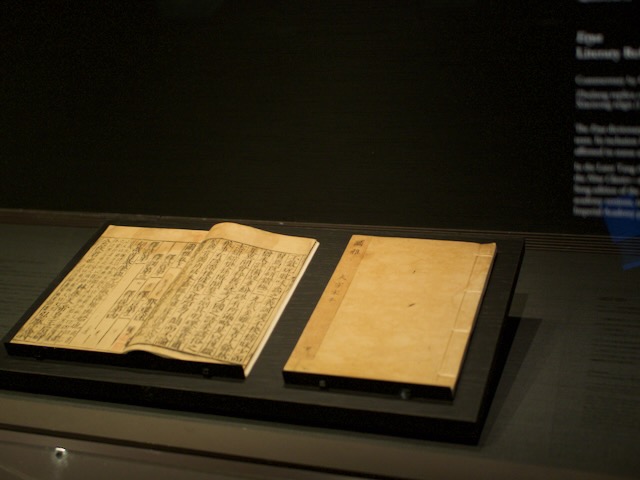
There's a hallway between major sections of the books section that is packed full of book collections. There is a complete edition of the Complete Library of the Four Treasuries, with 3,000 types of books, that shows just how important written, offline history can be. In particular, these books enabled scientists and academics to understand how Chinese languages changed over time. The incredible dedication of the staff who cared for this collection, who transported it across vast lands and waters, dodging conflicts and conflicted peoples, should be recognized equally to the artifacts themselves.
We left the National Palace Museum as they were closing at 5pm. I think one could spend several days exploring the museum as some exhibitions were very busy and would take longer to move through due to queues.
Later in the day, Shilin Night Market would be our venue for dinner and exploration. The night market is vibrant, sprawling out of the Shilin Market building and into the surrounding streets in the neighborhood. In Taiwan, the "small eats" available at the stalls and storefronts are inexpensive, tasty, and ever evolving to meet the tastes of the primarily young crowds. The customers come in waves, as the school day ends, as workers get out of their jobs, as tourists transition from museums to the streets, starting near 5pm and continuing late into the early morning.
Secondary schools in Taiwan, and other countries, end near or after 5pm, so groups of students find the night market an inexpensive place to get some bites to eat, socialize, and decompress from school. As I walked to the market area, I wouldn't need a map if I just followed the clusters of students with their backpacks and in their uniforms.
Mixed in with the food vendors are games for younger children (including what looked like pachinko), shooting, dart throwing, and reaction games where you can impress your date and win a stuffed animal or other prize. For adults, and those with more spending money, there's clothing, books, toys, gifts, and more. Some of the storefronts do not open at all during the morning and afternoon, instead awaiting the throngs in the evening.
I struggle to find a comparable to this in the United States. Farmer's markets are open during the day, typically, and cater to adults. Food halls are rare and usually priced above market. Why is this? Why are night markets so rare in the United States? I think the blame lies in zoning, litigation, higher labor costs, and car orientation. Regulators would need to be open to more risk, lower costs to license and inspect, and have built institutional capacity for handling the difference in volume and dynamism that is inherent in "small operator" (i.e. less capitalized, lower management capacity). Payment systems would need to be faster, less expensive, and optimized for purpose.
All that aside, the standout food from Shilin was fried egg scallion pancake from a street seller just outside the core of the night market. The cart, situated outside a 7-11 (ubiquitous to the point of being useless as a wayfinding aid), was part of a two location business and grew a line while we were there. The scallion pancake inflated like a balloon as it fried, with the cook managing its position and eventually deflating it with a swift poke. A complex layering of flavors, from egg, a savory/sweet sauce, and a bit of hot sauce, were wrapped in a perfectly flaky scallion pancake. Surely, this is a hangover cure as well as a salve for the pains of the work day?
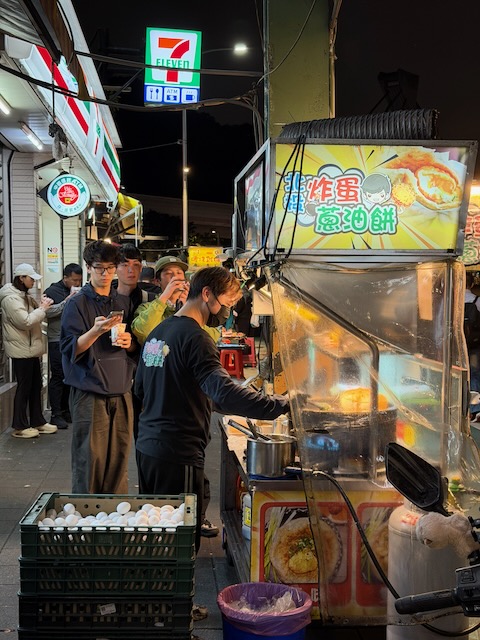
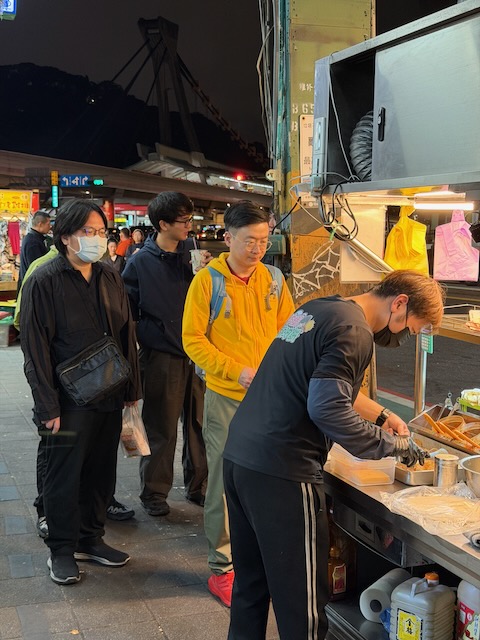
I have some video of the process, which I can share via email.
After getting our fill of foods (and one toy), we had a nightcap at Do Bar 獨角落. The cocktails were made well, by an attentive and cute bartender, and the karaoke area was in use by two young men with passable harmony. Next to us at the bar was a not-quite-beligerent drinker, who had finished about 6 beers before we had even arrived — I think we were relatively early compared to the night drinking crowd (and it was a Tuesday night). He eventually struck up conversation and regaled us with tales of selling the best, most recognized, most regarded tea in Taiwan.
It took a while to extricate ourselves from the looping stories, but eventually we did. As we walked toward the MRT, we passed through the hustle-bustle of the night market, navigating more dense crowds than earlier.
When my family and I visited Germany over a decade ago, my sister arranged our schedule. Key to the schedule was time and meals "on the economy" as most of the time we went to the nearby military base. Here, in Taipei, I was reminded just how important connecting outside the bubble, whether that be the tourist bubble or another bubble to be discussed later, is to understanding more about the world, about one own's country and systems, and one's own place in those. The night market experience made me think about the impact of tradition, regulation, and more on the use of private property and the public sphere. Is there a way, for example, for me to open a small cafe, serving my neighborhood, with low capital in the future? Right now, the answer is sadly "no".