Bunch of Books Recap: June in a Flash

In June, I went on a tear reading a decent handful of shorter books after the longer and challenging reads in April/May. I captured most of them as I went along on The Story Graph, which I had been introduced to years ago via the Lothians.

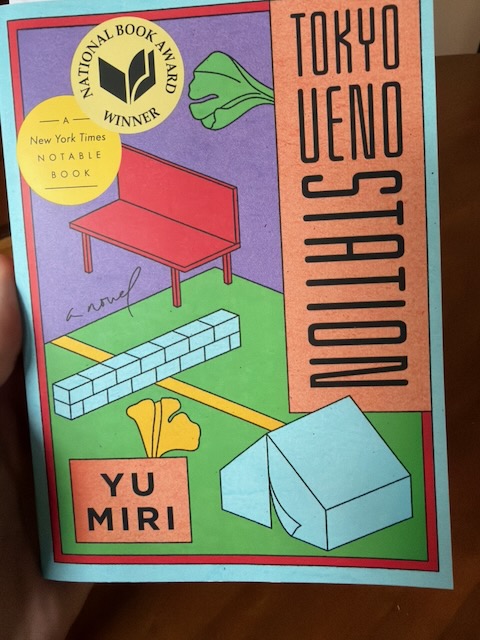
First up, Tokyo Ueno Station by Yu Miri. This book came to me via a recommendation through Instagram or The Good Place (not sure which). I guess I stuck in the "greater emotional impact than expected" books after completing Just Above My Head.  In this tight, sparse, philosophical book, we are introduced to Kazu, father, laborer, as he reflects on his life that spanned the modern Japanese era from 1933 to 2006. Drifting in and out of time and personal history, Kazu recounts his life as a migrant laborer, whether working at sea, building stadiums for the Olympics, or moving earth and materials by hand, and consequently spending years away from his family. As he is beset by the worst luck, he cannot make it out of poverty and a hardscrabble life.

The book portrays the plight of Japan's homeless population with care and precision, as Kazu — in his later years — escapes guilt, night terrors, and more to join the ranks of the homeless around Ueno Park. Reading this book after listening to Eight Million Ways to Happiness by Hiroko Yoda helped me understand better the complex, multi-religious aspect of Japanese culture, especially around death and funerary ritual. (I must insist that this book be listened to! Hiroko Yoda gives such a searing, funny, and loving reading to her book.)

I didn't say much about the storyline — it's ultimately a story of isolation, hardship, trying to do the right thing (but not achieving the outcome you expected), and criticism of Japan's societal flaws. Published in the wake of the Fukushima Daiichi nuclear disaster related to the 2011 tsunami, there's a potency here that I wish I could read in the native Japanese.

In Elisa Shua Dusapin's debut novel, Winter in Sokcho,  the French-Korean protagonist is working at a declining, seaside guest house in Sokcho (northeastern South Korea, within 20 miles of the demilitarized zone) through the winter. A guest arrives from France to find a new story and illustrate it for his newest graphic novel.

Sokcho is a cold, unforgiving place in the winter. The characters navigate icy courtyards, nurse frozen fingertips, and cultural chasms. The protagonist finds herself drawn to the graphic novelist, attempting to introduce him to what she believes is Sokcho's essence (a conflicted place, not yet healed from war, and marked by decline and despair). They circle around each other, attempting to connect and often finding a frisson of attraction.

I read this book in a day. It's very tight. The themes are potent (ranging from isolation to body dysmorphia to beauty culture). The author develops the characters beautifully and one is left almost wistful at the end.

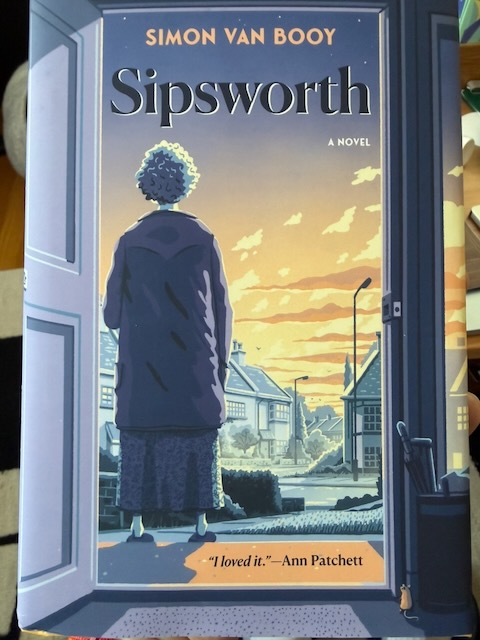
Sipsworth – Simon Van Booy

The prior two (Winter in Sokcho, Tokyo Ueno Station) had lonely characters, earlier in their life and after their life. "Sipsworth" also has a lonely main character. Helen Cartwright has moved back to her home town in England after thirty years away in Australia. Now in her eighties, her social circle is non-existent. Her days are simple: a slow ping-pong between bedroom, kitchen, and the living room where classic movies and modern news-noise emit from her television. Her trips to the grocery store (a long walk away) are crowned with a Bakewell tart, her one guilty pleasure.

Her routines and her isolation are disrupted one evening after she rescues some boxes and toys contained in a fish tank discarded by a neighbor. Over the following two weeks, Helen's world grows in leaps and bounds as she finds a new motivation beyond ticking down the life clock day-by-day.

The theme of finding community is very resonant for me. Helen actively avoids building relationships in her new-old town. She's fiercely independent and has had sufficient hurt in her life that she aims to protect herself with a shell. She turns to others when she's in actual need (and even then she's careful to portray it as a last resort) and finds that the humanity inherent in connection with others overrides her self-protection mechanism. Moving to a new place is hard. Rebuilding (or building) a fabric of connections with neighbors takes time and effort (and focus). I've talked with friends and family who give a range of 1.5 to 5 years to build that sense of connection and "I belong here" that truly feels real.

Published by Godine, a Boston-based publisher that I've respected for nearly three decades, this book is so British, precious, and joyous. It reinforces the importance of grace, second chances, and being open to friendship. Very lovely!

The English Understand Wool – Helen DeWitt

No picture for this book, as the cover is besmirched by a library tag that precisely covers the title…

The shortest book of the prior year… Maybe 70-ish pages of humor, snark, and quite unsubtle criticism of the publishing industry. Marguerite, 17 years old and seemingly abandoned by her over-the-top mother and contained father, sets off to write down her story for eventual publication. But she and her editor do not see eye-to-eye on how to take advantage of the press-and-social-media swirl that surrounds her current situation.

I picked up this book at my local library (West Branch of the Somerville Public Library) after chatting with one of the librarians about how featured books are selected. This one was not one of her selections, but I picked it up nonetheless. It was a total antidote to the other recent reads, even though the main character is also alone! DeWitt writes with panache and verve and I felt a great sense of joy reading of Marguerite's way of seeing the world (and her upbringing).

Glorious Exploits – Ferdia Lennon

This book came to be as a recommendation by one of my professors and friend Josephine Wolff. We were catching up and comparing summer reads. I love getting book ideas from friends and acquaintances because I learn more about the person and their interests (and I get to leverage the taste of people I trust).

Set in 412 BC on the island of Sicily, "Glorious Exploits" is a LOT of story. Lampo is a ex-potter, living at home with his mom, and he and his friend Gelon are unemployed. It's in the time of the Peloponnesian War and the Athenians who attacked Sicily were roundly defeated and (due to lack of space) imprisoned in the quarries. Somehow, out of this backdrop, Lampo and Gelon become co-directors of two plays (Euripides’ Medea and one other) by cajoling, the help of a producer, and the compelled participation of a handful of the Athenian prisoners.

I was about halfway through reading the book and complained how unsympathetic of a character Lampo is. I couldn't put the book down, though, because the characterization of everyone else (from children to set makers to buskers on the street) was just so, so good.

Great book. Standout debut novel by Ferdia, with a distinctive voice that weaves together contemporary speech and deeply historical references.

Disclosure: This post contains a affiliate links. I am an affiliate of Bookshop.org and I will earn a commission if you click through and make a purchase.

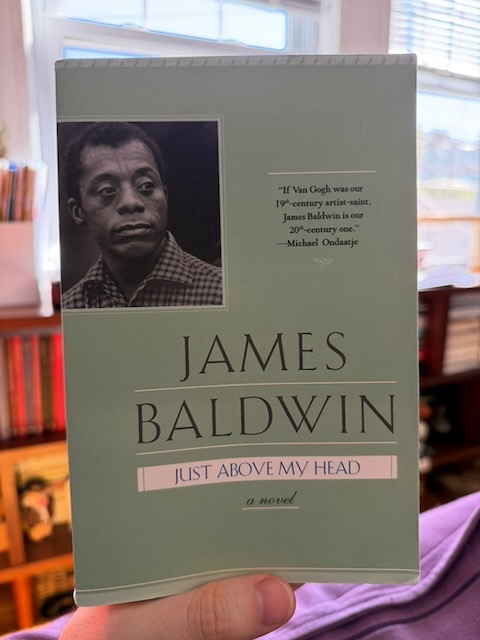
“Just Above My Head”

Published in 1979, James Baldwin's final novel brought me to tears and left me gasping. "Just Above My Head" tells a story of family, solidarity, love, and art through the story of a gospel singer (Arthur Montana) in the '40s through '60s. The narrator, Arthur's older brother and manager Hall, is part of an omniscient first-person storytelling frame as he recalls his beloved brother's life, loves, and rise to stardom.

Why did this book bring me to tears? The language. The passion. The genius writing. The incredible, abstract lessons and reflections that step out and above the timeline and narrative to shout from the rooftops "this is love!", "this is injustice!", "this is healing!". I had never read a book from a Black perspective in the Post-War/Civil Rights era; one that makes the debased threat of the Jim Crow South feel so present, so oppressive, and so real.

This is a challenging book. It has hard, difficult, painful, and triggering story elements (see content warnings elsewhere). And at every turn there is such deeply expressed joy, hope, wonder, and uplift. There are so many passages that could be lifted from the broader work and put on a pedestal of meaning, as they have such power and resonance.

The Honeymoon, Part II

I hinted at the whirlwind jaunt to get to Tower Eiffel and The Louvre. There's some background to this that will help set the context. The last time I visited Paris, it was at the tail end of a trip to visit my friends the Hendrick family when they were living in Germany. I thought then "Why not tack on a couple days in Paris before I fly home to the US?" I so wanted to take a long distance rail trip from Germany to France, check off another country (and an awesome one at that). So, I planned (very lightly) to leave the Hendricks and head to Paris via TGV. It was a beautiful spring. I distinctly remember one key thing from the train ride: yellow flowers from the rapeseed fields. The yellow was so bright, so extensive, and so impressive to my naive eyes. I had no idea what large scale agriculture in France looked like!

I also didn't understand that France, being a predominantly Catholic country, takes Easter very seriously. I arrived in a quiet Paris, mostly shuttered due to the Easter holiday. I went to the Louvre and it was closed! My clearest memories of that trip to Paris  was visiting Montmartre and eating ramen two days in a row at the same ramen-ya because it was open and I didn't have to use much French to order. The trip ended rather chaotically as I forgot to check in for my flight, didn't anticipate how long it would take to get to the airport (via taxi, I believe), got to the airport late, and then got to the gate late enough that the plane was already pushed back and on its way back to the US. I worked with a lovely Delta gate agent who booked me on a flight to Boston via an overnight stay in Atlanta. That overnight stay, thankfully, was at my sister's house after I called her and asked for her to pick me up in the middle of the night and bring me to the airport early in the day. Thank you, Castine, for your kindness that day!

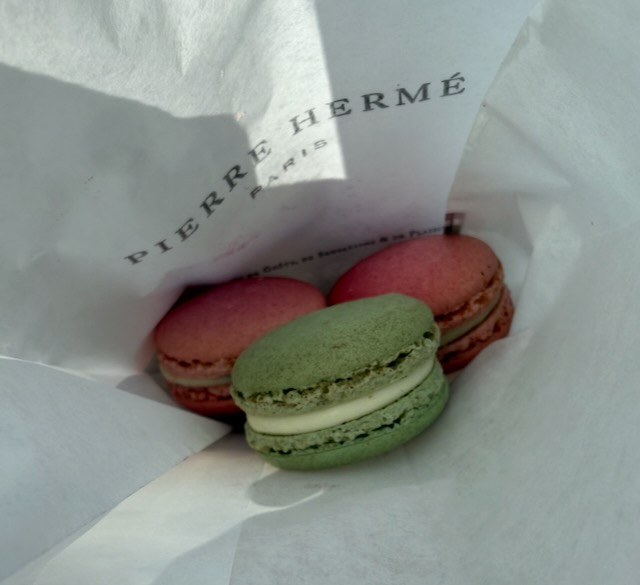
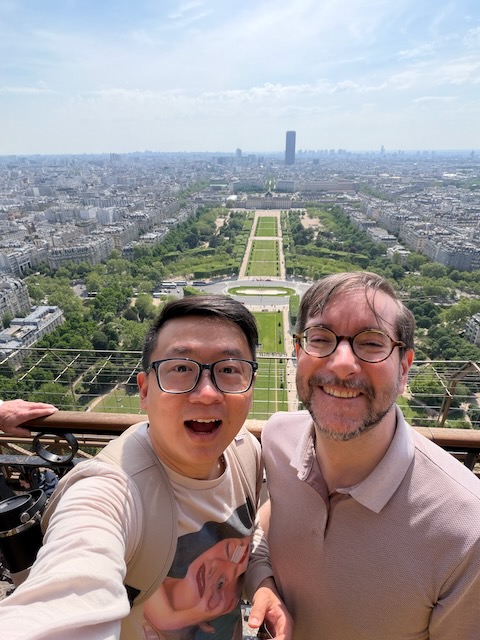
While one can acquire tickets to the top of Tower Eiffel online, I was not lucky or prepared (sound familiar?). We wanted to get to the tower earlier in the day, in the hopes that we'd acquire day-of tickets without too much queueing time. On our way, we stopped at Pierre Hermé for some macaron and cake. The Ispahan macaron was better than we had had before… by quite a lot. The macaron shell was far lighter and more finely textured than others from both competitors and a Pierre Hermé shop we had visited in an airport in the past two years. 

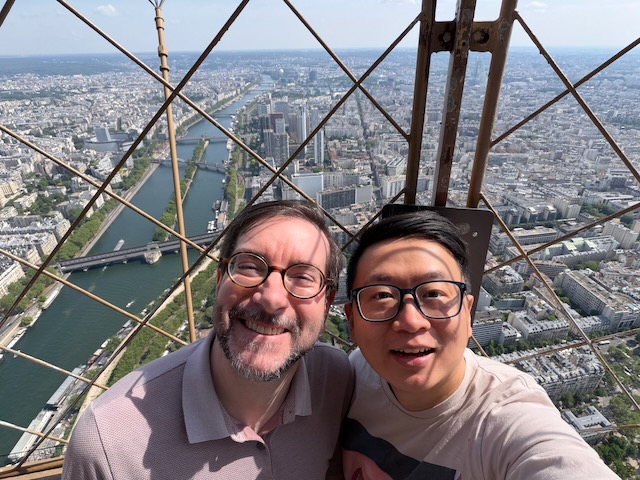
The Eiffel Tower is a beautiful structure and very accessible to those on foot. The surrounding park is now access controlled, with a security checkpoint that is efficient. As you approach the tower, the grandeur and complexity grows. The pillars (legs) of the tower are more than structure and safety mechanisms. The web of steel is occasionally enveloped by netting. Elevators (marvels of engineering in their own right) smoothly traverse the interiors of the legs and the South Pillar's stairs are busy with climbers and descenders.

It takes a while to get to the top. Occasionally the elevators are paused while overcrowding is reduced. The forty minute wait was worth it. The views are stunning. The connection to technology (radio and more) is deeply embedded in the structure and exhibition. What a great work!

We descended, crossed the Pont d'Iéna to Trocadéro, and then found a bus to the Louvre. Transport in the Île-de-France is robust, rapid, and easy but for the somewhat backwards payment system that requires a specialized transit card.

The Louvre is sprawling and, itself, a work of art. Between I.M. Pei's iconic entrance to the deep vaulted representations of crypts there is such an expanse of humanity. We spent three hours with sore feet and wide eyes exploring a tiny fraction of the museum. I can see returning again and again.

In order to get to Nice, our original plans called for a long distance train. By the time I went to book it, the fast trains were full, the slow trains were too slow (and nearly booked up), and for expediency Jeremy found an inexpensive regional flight from Orly to Nice. Transavia Airlines France is a low-cost carrier owned by Air France-KLM and is only 19 years old! Low-cost carriers are an interesting feature in the European markets (famously Ryanair is the lowest cost of low cost carriers) that I'd like to see more of in the US market.

We ended up in Nice around 10:30pm and after some minor airport public transit frustrations (even more oddly restricted transit card system from Lignes d’Azur) we made it to our hotel. Our travel days were very long, but we rarely had travel crankiness (I probably had the most). Is that the result of this being a honeymoon or a result of having fluid travel plans? I'm not sure!

The Honeymoon, Part I

Hello from Paris, where we're staying near Gare de Lyon for a couple days before heading to the southern part of France for the bulk of our honeymoon.

We decided to return to work after the wedding instead of heading straight into a honeymoon. That was a good decision. The week after the wedding was a blur of poor sleep, late afternoon naps, and general mental exhaustion. I cannot imagine the misery of packing up the venue, getting home, feeding the cats, then immediately getting on a plane to a far-off destination. I'm certain, though, that I'd be a grumpy, petulant child during that period. That would not be ideal for the first big trip as husbands.

Husbands. Husband. Have I used that word a substantial amount over the past several weeks? Yes. I husbanded within days of the wedding. Jeremy husbanded in a work conversation the day before we boarded the airplane. I was advised to use "fiancé" liberally during the time we were engaged and I certainly did, because that term is fleeting compared to husband or partner.

We're staying in one of those slightly too chic hotels, but it's worth it for the location and the extensive space dedicated to just relaxing and socializing.

From here, we've wandered quite a bit. I was asked today where we went and I could barely articulate anything from the day.

Yesterday, I know we went to Musée d'Orsay because it was an evening extended hour period. What a glorious building, a train station rescued from decline and transformed! We saw a great collection of Renoir, which included pieces from MFA Boston, The Clark and others that we had seen before. We stayed out late, watching groups of teenagers and 20-25s chat away the evening on the shore of the Seine and then wandering to Notre-Dame de Paris. The day was full of sun, avoided sunburn, and walking. We read and sketched at a cafe. After such light sleep on the plane, I don't know how we had enough energy to continue to be motivated.

Today we started much later, after giving ourselves permission to sleep late. I haven't slept as soundly and as long in quite a while — eight hours plus, easy. Much lighter schedule today, but I'm writing this around 6pm and my "dogs are barking" (as they say). Since we woke up so late, we wandered slowly along Viaduc des Arts taking in the floral and architectural wonders. It beats the NYC High Line in many ways (including how focused on artisan enablement it was/is). Our lunch was at Jouvence and was excellent from service to timing to taste. Very talented crew creating and actualizing the dishes.

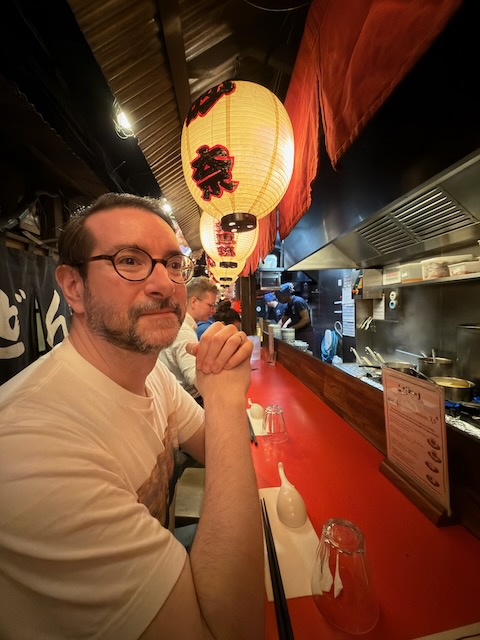
We wandered a lot on May 1st as many things are closed for Fête du Travail (my second national holiday in France, I think it'll become a tradition). We spent time at a Biological Garden, read and sweat in the 75+ heat. Glorious steps, all 20,937 (nearly 9.3 miles) of them. We finished off the day at Kodawari Ramen (Yokochō).

The ramen shop is very tight, modeled after an alleyway restaurant. We were tight up against the kitchen space, where the team of three were continuously preparing bowls of ramen for the hour or so we were there. We chose different ramen between us, of course, and they were quite different from others I've had. Mine (Kurogawa Ramen 黒ごまラーメン) was deeply colored by black sesame paste, thick and clingy, with a hint of sansho pepper in the spice mixture. Jeremy's (Niboshi Paitan Ramen 煮干し白湯そば) was lighter by comparison, with a very rich chashu completing the dish. We finished off with a café daifuku (coffee ganache inside) which was one of the best we've had. Definitely made with skill both in flavor and in technique.

I'm finishing this off a couple days after 1 May. My feet are not yet recovered from that marathon May 1st! Paris, Part II, is a bit abbreviated because we spent a little under six hours packing in a whirlwind jaunt to Tower Eiffel and The Louvre. Perhaps tomorrow I'll get to write about that and our 1.5 days in Nice.

Recipe Reminder: Cod Grenobloise

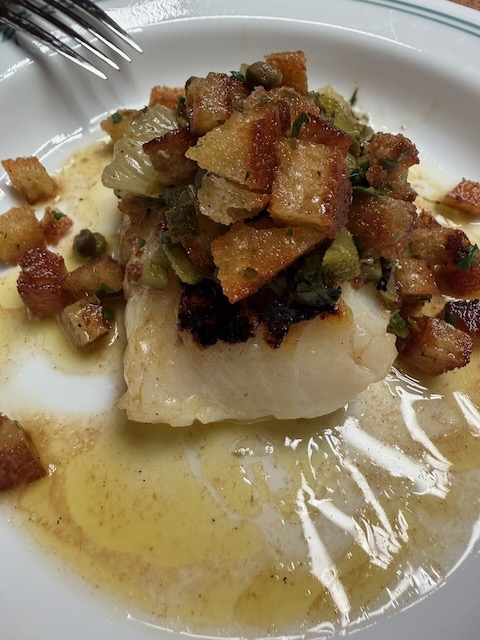
This was a complete winner. I've shied away from lemony dishes recently, but this French classic dish delivered an incredibly balanced, tart, and exciting flavor profile.

I am not sure how this video ended up in my "to watch", but it did and I pretty much followed Adam Byatt's approach. The dish comes together quite quickly after the mise en place is set.

Before starting, pull out the cod and pat it dry. Coat it liberally with a 60/40 blend of table salt and sugar (25 g table salt, 15 g sugar) and allow to cure for 12 minutes. Rinse, pat dry, and rest (for best results uncovered overnight).

Active time: 25 minutes Serves: 2

  • 250 g – Fresh Cod fillet

  • 100 g salted butter (good quality)

  • 1 lemon – segmented with the juice reserved

  • 20 g capers

  • 20 g cornichons, diced

  • 2 slices of sourdough, small dice

  • 20 g flat-leaf parsley, finely minced

  • 20 ml white wine

  • 100 ml fish stock (or suitable replacement)

Melt half of the butter in a sauté pan and toast/sauté the diced sourdough over medium heat until golden and crisp. Drain well.

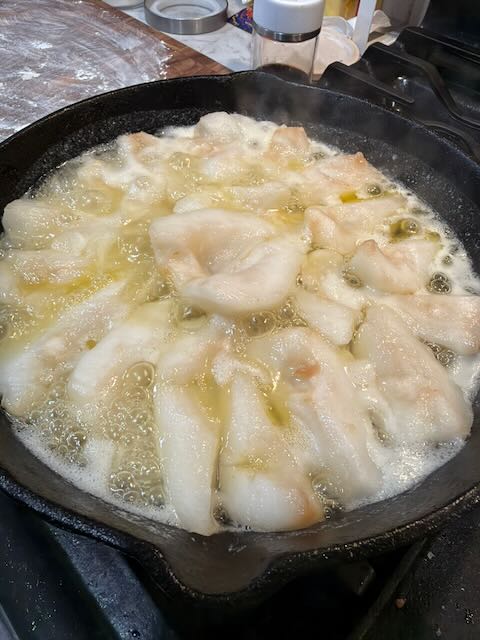
Once removed, heat up some good quality olive oil on medium-high. Pat the cod dry and place flesh-side down and do not move for 6-8 minutes. Allow the flesh to take on a good color and crust and it will release when ready. Remove and flip so skin-side is down in an ovenproof dish (I used a small sheet pan with a layer of parchment). Add fish stock and put additional chunks of butter on the fish. Braise at 320-350F for 6-8 minutes, remove and rest.

In the same pan, cook the remaining butter to a beautiful brown. The way to tell this is that the butter will foam, and as you swirl it around to keep it from burning, the foam will part. As soon as the foam parts, immediately squeeze/add the lemon juice — there will be spattering — and then the white wine. Shake vigorously to emulsify. Rapidly stir in the diced cornichons, capers, lemon segments, croutons, and parsley. Warm up slightly if needed!

Serve fish (skin removed) over warmed up cauliflower purée on the plate, then spoon the sauce over the fish. Finish with a tad bit of good quality olive oil. It's tremendous. The piquant character of the sauce elevates the fish from "okay" to transportive. We had leftover sauce and as the night went on we ate spoonfuls of it alone.

Just A Quick Log

There's a lot going on right now! My fiancé and I are in the final 30 days before our wedding, the world is full of conflict and change, and I'm trying my best to continue to read as much as I can. And avoid deep time sinks. And occasionally (often?) failing…

It's Saturday morning and the house is quiet, the road is quiet, the trains are (somewhat) quiet, but outside I can hear the springtime calls of the birds. Their excited chirruping heralds the true arrival of Spring! The cats are intrigued by the birds return and have spent much time staring out the windows, with their heads on swivels. 

In February, I wrote about the non-fiction I had been reading and hinted about the two more substantial novels I had read. I'll add to the non-fiction list below, in a more "capsule" approach than typical:

  • "Careless People" – Sarah Wynn-Williams was a former New Zealand diplomat and international lawyer. Her memoir is centered around her experience as an early member of Facebook's public policy team. I had heard that this book was incisive, painful, and revelatory. That's an understatement. Like Jacinda Ardern, the former New Zealand PM whose memoir I read in 2025, Sarah Wynn-Williams blends humor, pathos, frustration, horror, and almost polemic. She deftly paints an incredibly rich, revelatory picture of power, greed, id, ego, and ignorance that exposes the flawed surreality of rich and powerful people around the world. Her view from within Facebook is incredibly valuable for understanding the base mechanics of attention and money and fear of irrelevance that motivated, often to ill ends, that organization, but also apply more broadly to the world. I laughed, winced, and gawped as I read, often putting the book down to shake my head and mourn.
  • "The Unseen Truth" – Sarah Lewis, an associate professor at Harvard University, comes to interrogate the racial regime from a completely unexpected perspective: visual. This book, like the academic works from last month, was challenging to read, especially due to its very specific language. Dr. Lewis points the reader to what was, and is, left out as evidence of the false foundations of racial hierarchy, stretching back to wars in the Caucasus and the U.S. Civil War. What does the term Caucasian even mean? How did it become synonymous with White? This book explores that and art, maps, photography, seeing, ignoring, conditioning, and more. An incredible synthesis of history and visual representation that exhibits some of the problems of academic writing but overall delivers the reader to a place of questioning and realization.
  • "The Beginning Comes After the End" – Rebecca Solnit, a long time environmental and human rights activist, delivers a punchy, eloquent, and tight 131 page reflection (and partial paean) on the past 60-70 years of slow-but-fast transformation and societal change. Her core thesis is that the current rise of authoritarianism is a reaction to the stunning progress in rights for more people and environments. By the end of this book, I felt:
    Hopeful
    Recognition that our own commitment to justice and equity is important, no matter how "small" it feels
    Inspired to be present
    Excited to build a better future together!

So, what about those two novels I read? When did I even read them? What were their titles? Listing them below as a reminder… (I don't use a book review/book logging website right now, even though I tried to use The StoryGraph last year.)

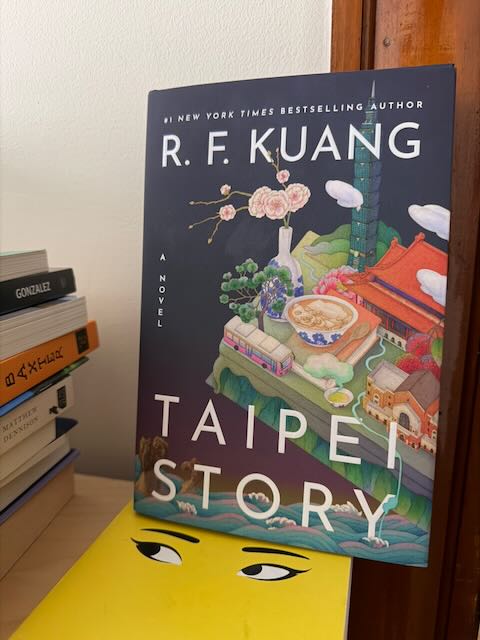
  1. "Babel: Or the Necessity of Violence: An Arcane History of the Oxford Translators’ Revolution" by R.F. Kuang
  2. "Pachinko" by Min Jin Lee

I'll write about these two (around 1000 total pages) later. But I've already started reading the next six hundred page honker just yesterday evening. 

Disclosure: This post contains an affiliate link. I am an affiliate of Bookshop.org and I will earn a commission if you click through and make a purchase.

Recipe Reminder: Twice Fried Chicken

This isn't truly a recipe, but more of a self-reminder of how well Air Fryer Ssamjang Twice-Fried Korean Chicken turned out tonight. The key part of the recipe was the sauce, noted below and modified.

Active time: 25 minutes per batch (2-3 batches) Serves: 4

  • 8 Tbsp. ssamjang (2 Tbsp. gochujang + 2 Tbsp. of ketchup or bean paste)

  • 4 Tbsp. honey

  • 4 Tbsp. brown sugar

  • 2 Tbsp. soy sauce

  • 1.5 Tbsp. sesame oil

  • .5 Tbsp. Green Sichuan Peppercorn oil

  • 2 Tbsp, fresh ginger, grated

  • 4 tsp. Fresh garlic, minced

Combine all together, blend until smooth if you want to waste a clean blade. I halved the recipe for Jeremy and I.

For the chicken:
Mix salt, pepper, and 6 Tbsp. of cornstarch or potato starch in a sealable container.

Pat dry chicken thighs, then toss with a small amount of oil.

Put the oiled chicken thighs (skin on is better) into the container with the cornstarch mixture. Shake until well coated.

Preheat air fryer to 375℉. Shake off excess starch and place chicken into the air fryer basket. Air fry for 15 minutes. Flip, air fry for another 7 minutes at 400℉. If you need more time, give a little spray of oil to the chicken and then go another 7 minutes.

Remove, dip into half of the above sauce, then serve with a side of rice.

Non-Fiction Catchup: “Nature Behind Barbed Wire” and “Vivian Maier: A Photographer’s Life and Afterlife”

It's been a particularly full several weeks of reading, but before going into the two novels that dominated the time, I thought it'd be good to set down some thoughts about the non-fiction I've been reading. Both works are by academics, professors that are experts in their fields, women, and great storytellers.

First up: "Nature Behind Barbed Wire" by Connie Y. Chiang. I picked this book up when visiting Bowdoin College's art museum last year. It was on sale and the subtitle ("An environmental history of the Japanese American incarceration") caught my eye. This book is the first I've read where the term "incarceration" was used in relation to the World War II internment of Japanese-Americans. The author wrote this book using the environment as a way to explore the trials and travails of Japanese-Americans during the carceral programs that forced them off their leased land (typically the farmers) and away from their livelihoods. Drawing from oral histories, statistical reports, memoranda, and public information, Chiang expands her thesis and humanizes the often rough interface between man and nature. Very impressive work.

But, not as impressive as Pamela Bannos' "Vivian Maier: A photographer's life and afterlife." This remarkable tale of Vivian Maier, famed "nanny street photographer", is far more educational than I expected. Exceedingly well sequenced, this work tells the story of Maier in great detail, alternating between the reconstructed historical record and the modern day fervor that surrounded Maier's "discovery". What truly put this book in a different league is just how well Bannos integrated the broader historical context, both globally and in the minutiae. I feel like I could read the book again and learn even more about the U.S. in the '40s – '90s. Maier was prolific in her photography and film, as well as excessive in her somewhat obsessive collections of other material, and the story of her in the broader cultural context is well told through careful sequencing and understanding of the photographic record. I think Bannos' insight, which is that Maier was photographer first (nanny second), changes completely how we understand Maier and is likely truer to her than other media (movies and otherwise) that followed the hype cycle.

Standout works for their academic importance and compelling narratives.

“Monstrilio”: Grief is not a black hole

It often takes a while to be ready to read a new book. I'd been picking away at "Nature Behind Barbed Wire" for more than two months, reading tiny increment by tiny increment, and finally finished it. It's an academic work that explores incarcerated Japenese-Americans relationship to their environment during World War II. My next book would have to be radically different in tone, energy, and theme — I needed a quick, powerful read.

That next read was in my to-be-read pile where it had hidden since I found a copy at Sidequest Books & Games in Somerville, MA. Originally, I heard about it via Instagram, a "bookstagram" account belong to esje, a Filipino-Chinese who lived in Bangkok and recently moved to Amsterdam. This debut novel of Gerardo Sámano Córdova, Monstrilio, consumed my reading time the past several days with an intensity I've not felt in a while. Published in 2023, Monstrilio is difficult to categorize — it's not simply horror or queer lit or folklore. I've never read anything like it.

The novel is broken into four major sections, each from the perspective of a different character and mostly chronological. The core of the story, the root from which the complexity grows, is the death of Santiago, Magos and Joseph's 11-year old son, from complications from pulmonary agenesis (unilateral) — the condition of being born within one developed lung. Magos and Joseph are a bi-national couple, spending time between Mexico City and upstate New York, while living on Joseph's trust fund. Upstate New York was easier for Santiago and his condition, but it's where Santiago ends up dying at home. 

In an inexplicable act, Magos, driven by a desire to "learn one last secret from her son" excavates a chunk of that defining lung with a paring knife.

From this gory scene, Magos' section is first and builds her character from an unknowable corpse mutilator into almost (just almost) a sympathetic player in the story. The world surrounding the characters is powerfully insular, where the real world's intrusion for fact finding and plainly deserved prosecution is kept at bay through chance, personality, or perhaps some powerful magic. It's folk magic that animates the lung chunk after Magos takes it, and herself, to Mexico City and hears a story from her mother's housekeeper of a child reborn from a piece of heart. Bending herself, and her family and close friends, into collaboration, Magos feeds and grows the Santiago-chunk into something… a monster… that represents her rejection of loss and concentration of grief.

It's through this lens of loss and grief that the story develops, slowly and then with desperate speed. Grief colors each character's internal monologue and external presentation, but it's far from a black hole. Much springs from the grief core of Monstrilio from Jonathan's bottoming out, avoidance, and connection with a new love to Monstrilio (M) himself finding his own way through a claustrophobic, constraining existence to freedom in the end.

The writing, the sense of unique voice, here is beautiful and alive. I am so impressed with how Sámano Córdova uses word choice, sentence and paragraph structure, and variations in descriptive character to give each main character their unique voice on the page. The book cries out for re-reading, a closer reading, after the first hanging-on-for-dear-life read. Sometimes dark, and occasionally bloody, this book has a heart (or lung??) that beats (breathes) with familial love and hope for understanding. 

I unabashedly recommend this book. It's powerful and inspires consideration of complex and simple themes. Certainly one of the best books I've read in the past year.

Disclosure: This post contains an affiliate link. I am an affiliate of Bookshop.org and I will earn a commission if you click through and make a purchase.

Contextual Reading: “The Old Garden”

Side Note: I tend to write chronologically, because first this happened, then that happened, and I fret that it's a trap/framework/habit that is immature or constricting. When writing a travelog, chronological is the default and I'm trying to challenge that habit, because I aim to write more and differently.

I haven't been reading as much as the middle of last year (although, it's only January). A standout that straddled '25-'26 is "The Old Garden". A political prisoner, Hyun Woo, is released after 18 years and reenters South Korean society to find that his lover, strong-willed artist Yoon Hee, has died. She wasn't allowed to visit him while he was in prison, but wrote her story expecting his release. The book incorporates his perspective as a pro-democracy activist around the Gwangju Uprising and her perspective as artist and instructor (including her time in Berlin during the fall of the Wall). The story spans twenty years and, despite it's time breadth, maintains propulsive energy underneath the contemplative, intimate, and reflective prose.

I knew a little bit about South Korea's history and the anti-democratic, autocratic forces that ruled it for decades but this book opened my eyes to the struggles of regular people in our lifetimes to advance pluralistic and democratic societies. While I was visiting Chongqing earlier this month, I visited the site of the Provisional Government of the Republic of Korea which operated in China during the Japanese occupation of Korea. When in Taipei, the Chiang Kai-Shek Memorial Hall had an exhibition called "Flowers of Freedom" which portrayed the Gwangju Uprising in the broader historical context of the ongoing fight for democracy. These two places informed how I read the book and emphasized that twenty years is a blink of the eye!

This book gave deeply personal (fictional) context for the fifty years that followed the liberation of Korea in the 40s. Together, the book and the visits to Korean historical sites in China painted a nuanced picture of an 80 year period of turmoil and change. The writing in the book, originally in Korean by Hwang Sok-yong and translated by Jay Oh, is beautiful and sometimes strange. The voices of the main characters are distinctive, which allows the characters — separated by time and the veil — to be in conversation in a way I hadn't experienced before. Quite a worthwhile book, packed with moments that force a pause to reflect on one's own values, understanding of self, and understanding of historical context.

Disclosure: This post contains an affiliate link. I am an affiliate of Bookshop.org and I will earn a commission if you click through and make a purchase.